I’ll admit that I’ve been paying very little attention to poker outside the scope of the small amount of writing I do for one remaining client. Even this doesn’t require me to stay up to date on the latest events, tournament results, or the vast majority of players. I only have a handful of friends from the poker world with whom I interact in any way online, so the wider world of poker doesn’t enter my sphere often anymore. Even so, I occasionally see news from Las Vegas, as the World Series of Poker (WSOP) and numerous other tournament series are happening there for the summer.
The first few summers that I didn’t do any serious reporting from the WSOP were tough for me, as I felt out of the loop, disconnected from an industry in which I had been immersed for two decades. But now, nearly 25 years after I found my writing voice in poker, I’ve made peace with my disconnection. My work for one client and my few remaining friendships are just enough to allow me to peek inside the window of that world just enough to be glad I’m not in there all the time.
Then, something significant happens that evokes such a reaction from me that I feel the need to say something.
Women in Poker
I’ll start by saying that I spent many of my years in poker advocating for women in poker. I learned over my initial years in the game what women faced at the table – the harassment, bullying, misogyny, and direct and indirect verbal abuse. That doesn’t even take into consideration the loneliness, intimidation, and insecurity that can affect a woman’s play – if she decides to play live poker at all – because she is such a minority in mostly male poker rooms and tournaments.
I came to realize that women-only tournaments often offer a less intimidating environment in which women can enter the game or play without fear of being sexualized or demeaned, bullied or generally made to feel that she doesn’t belong. Thus, I supported these tournaments, encouraged women to play, and spent time defending these events in countless opinion articles and on social media. And sometimes, women who enter women-only tournaments often gain the confidence and desire to play more open-field events as well. It was one of the ways that poker could welcome more women into the game as a whole.
Most poker tournament series organizers got on board over time. They responded to requests for women-only tournaments, improved structures when women demanded fairness, helped to decrease sexualization and condescension that some tournament staff used to display in and around those events, and some even increased guarantees and buy-ins over time. None of this happened organically, but the female contingent in poker used their collective voice to spur change as the years progressed.
Women at WSOP
The World Series of Poker had its share of issues over the last two decades with regard to non-male players. In fact, the very first women-only tournament was introduced in the 1970s, though only as a way to keep women from interfering in their husbands’ play and giving them something to do while their male partners played serious poker. In the early 2000s, during the poker boom when the WSOP worked alongside numerous poker entities to host a poker expo of sorts, the first few iterations were filled with strippers and women in bikinis promoting poker sites. The WSOP leadership took steps to improve their treatment of women over time, again when women collectively demanded better (and progressive men supported those efforts).
As the annual WSOP Ladies Championship tournament started to deliver larger numbers during the poker boom, some men simply couldn’t handle the fact that one tournament out of dozens was set aside for women only. So, a few men entered the tournament, as Nevada law prohibited discrimination, in the name of “fairness to men” or due to the “softness” of the field (meaning women were easy to play against and defeat). Of course, there were also a handful of men who thought it would be funny to dress up as women and enter the tournament as a joke.
HA. HA. HA.
Eventually, the WSOP found a workaround to stop men from playing that singular tournament each summer. In 2013, the WSOP decided to implement a new rule stating that women would pay the traditional $1,000 buy-in to play in the Ladies Championship, while anyone clearly presenting as a man could play but would have to pay a $10,000 buy-in to do so. That year was the first in recent memory that no men played.
Trans Women in Poker
Considering the discrimination that many women still face in poker (yes, in 2026), it is not a surprise that there are few openly trans women in poker. There are a few of whom I’m aware but none more visible in major tournaments than Aubrey Williams. She has registering live poker results since 2019 and is a staple in East Coast poker, having earned nearly $500,000 in live tournaments (not including online poker) per the Hendon Mob database to date and capturing several tournament titles. Most recently, she won the BetMGM Borgata Winter Poker Open Hybrid Championship (played online and live) for more than $52K. And this week, she finished second in the WSOP Ladies Championship in Las Vegas for her largest ever live tournament cash of $129,692.
No one at that livestreamed final table had an issue with a trans woman at the table. Moreover, many of the players in the tournament and several at the final table were already friends with Aubrey and didn’t give her gender a second thought. She has long presented as a woman, and she plays women’s tournaments, though she is a respected player in the game as a whole, not to mention an upstanding and good human.
Who had a problem with Aubrey? Men.
Interestingly, these men are not known for standing up for women in any situation, but suddenly this contingent of the poker community tried to act concerned about a “man” playing in a women’s tournament. And they expressed their feelings in disgusting, hateful, and offensive comments across social media and on the WSOP livestream of the Ladies Championship final table.
Livestream and X Transphobia
There were several days of livestreams for the Ladies Championship due to high demand for such in previous years. I didn’t catch any of them as they happened, but I did go back and watch a bit of Day 3 and then Day 4, the latter of which was the final table. Aubrey was a prominent figure on both of those days due to her solid play and substantial chip counts.
The Day 3 livestream offered Joe Stapleton and Jennifer Tilly as the commentators, and as I watched the chat while listening, I noticed that there were extra chat moderators warning against inappropriate comments. And it didn’t take long for them to start deleting comments. Just minutes into the livestream of the action, Aubrey was in a hand, and comments that made it past the moderators included “there’s the man” and “adams [sic] apple”, though a great many comments were deleted during the original livestream, so I was unable to see them in the rebroadcast.
For the final table livestream, Celina Lin joined Joe for commentating duties, and Joe chimed in after just the first hand to say, “I would just love for… if all of the misogynists and transphobes could make yourselves known right now in chat so we can ban you now, that would be great because I would like to focus on this. I do get great pleasure with removing your chat privileges for the rest of your life on the World Series of Poker channel, so just do it now, and then we, the rest of us normal human beings who aren’t terrible people, can enjoy what we’re watching.”
The moderators had their hands full again, as other comments suggested that when it was live, the transphobic comments were being deleted right away.
The same could not be said for X (Twitter). While I only follow news accounts there now, I clicked on some posts about the Ladies Championship when I heard about the comments regarding Aubrey. They were abhorrent.
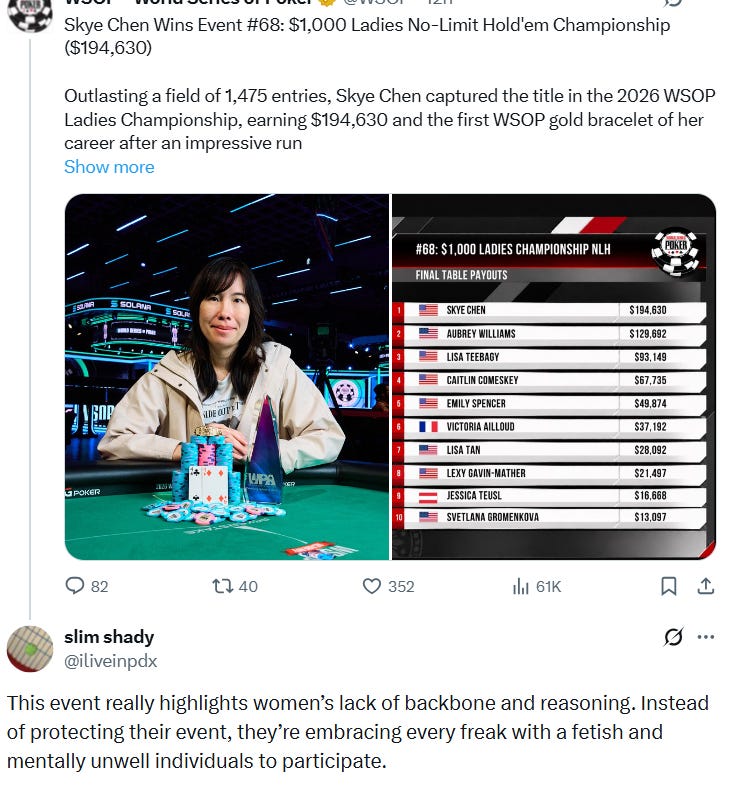
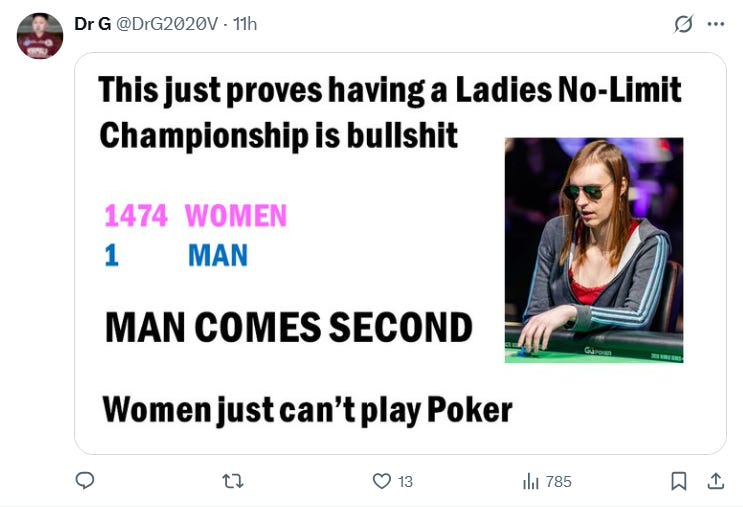
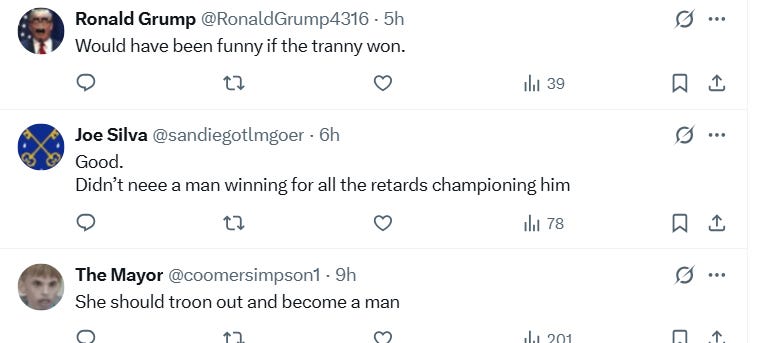
And when another woman at the final table, Caitlin Comeskey, stood up for Aubrey, she became the target of the vile hatred as well, so much so that she eventually turned off the ability for people she didn’t follow to comment.
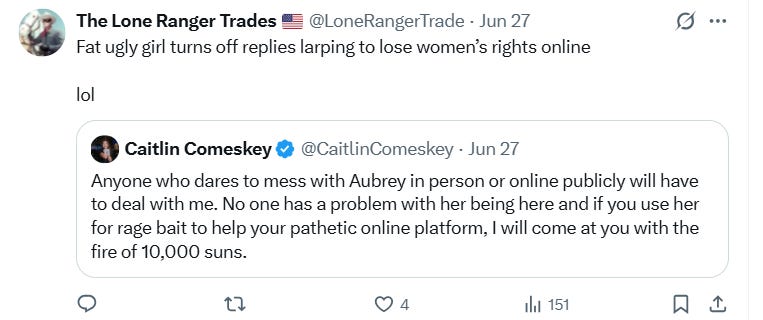
WSOP Silent as Always
The World Series of Poker could have taken a stand on this and stood up for its players like Aubrey. The company could have quieted the angry mob by saying that Aubrey was welcomed in the Ladies Championship and all events, that they respect their players, that they condemn the hatred hurled at Aubrey.
The company, the organization that is the WSOP, did nothing of the sort, of course.
Kudos to Some in Poker Media
Several members of the poker media – the vast majority of whom are male at this point – did stand up for Aubrey.
· Matt Hansen at PokerOrg wrote: “Aubrey Williams, who has shown nothing but class and professionalism at every step of her poker career, faced a wave of ugly bigotry on the internet and in the livestream chatrooms throughout the first two days of the tournament.”
· Connor Richards at PokerNews wrote an entire article, saying in it: “Williams, a transgender woman, entered today’s Day 3 tied with the chip lead. And while her table mates greeted her with friendly smiles and open arms, her deep run created a stir in some anti-transgender social media circles.”
· Rebecca Scales at Women Poker News: “The strength of poker is not found in a rulebook alone; it is found in the character of those who choose to face one another with integrity. We do not need to share the same viewpoints to offer the basic respect that every human being deserves.”
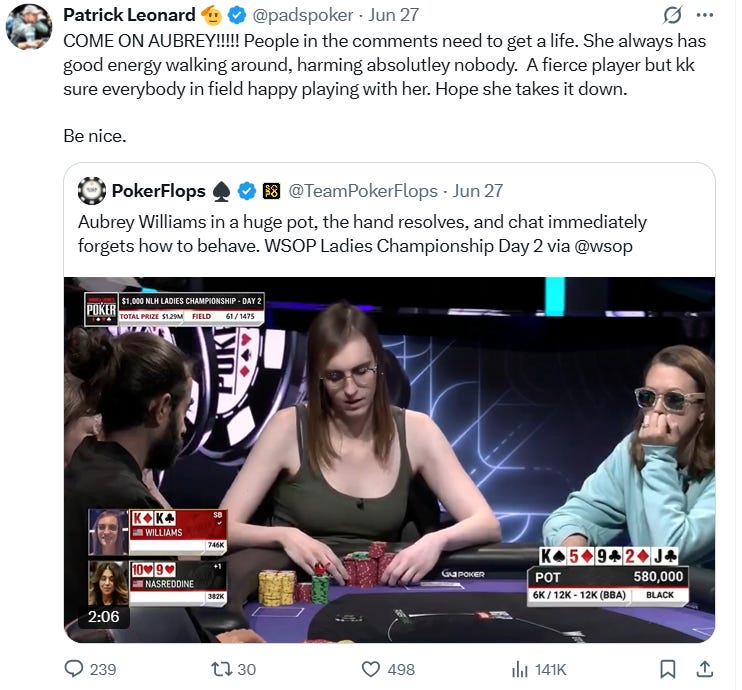
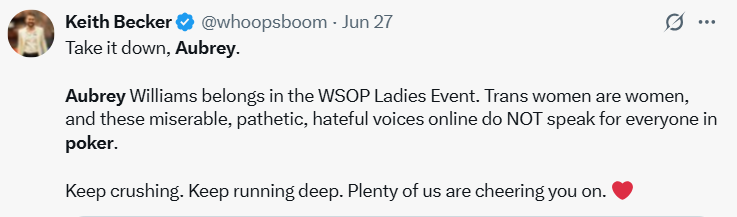
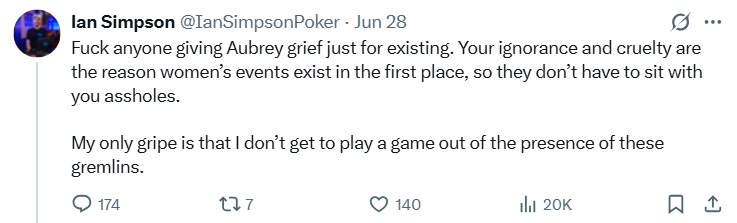
A number of poker pros, including some men, did chime in to support Audrey.
Men Have a Trans Problem
By all accounts, most of the hatred toward and about Aubrey came from men. Of course, men speaking out against trans women in poker, just like men speaking out against trans women in sports – all because they’re advocating for women. Men to the rescue. They’re just thinking about women and integrity and fairness; that’s all. Right?
Here’s a suggestion for everyone who has a concern or problem with our trans brothers and sisters or, for that matter, anyone who doesn’t line up with your traditional notion of male and female genders:

Let people live.
If you can’t love them or respect someone because you don’t understand them or care to understand them, that’s your problem. Walk away – literally and figuratively – if you can’t treat people with decency and kindness.
I’m so happy you wrote this! I have been horrified by the hateful comments. Among other things, it has been such a distraction from Aubrey’s stellar play this week. I have so much respect for how she handles these situations. She is very brave. ♥️